
2026-08-15 · Science · 32 min read
Prince Rupert's Drops: How a Glass Tear Survives a Hammer and Explodes from Its Tail
A drop of ordinary glass can survive a hammer blow and then break into tens of thousands of fragments when its tail snaps. Its history and physics took more than three centuries to untangle.
I had seen the videos before. Someone places a glass object shaped like a tadpole on an anvil and hits its round head with a hammer. Nothing happens. Then they pinch the thin tail with a pair of pliers and the whole object vanishes in a sharp crack and a cloud of glass dust.
It looks like a trick made for a short video. The obvious explanations arrive quickly. Perhaps it is a special kind of glass. Perhaps the head is hollow. Perhaps the hammer strike is carefully staged. Perhaps the tail contains something explosive.
None of those explanations is right.
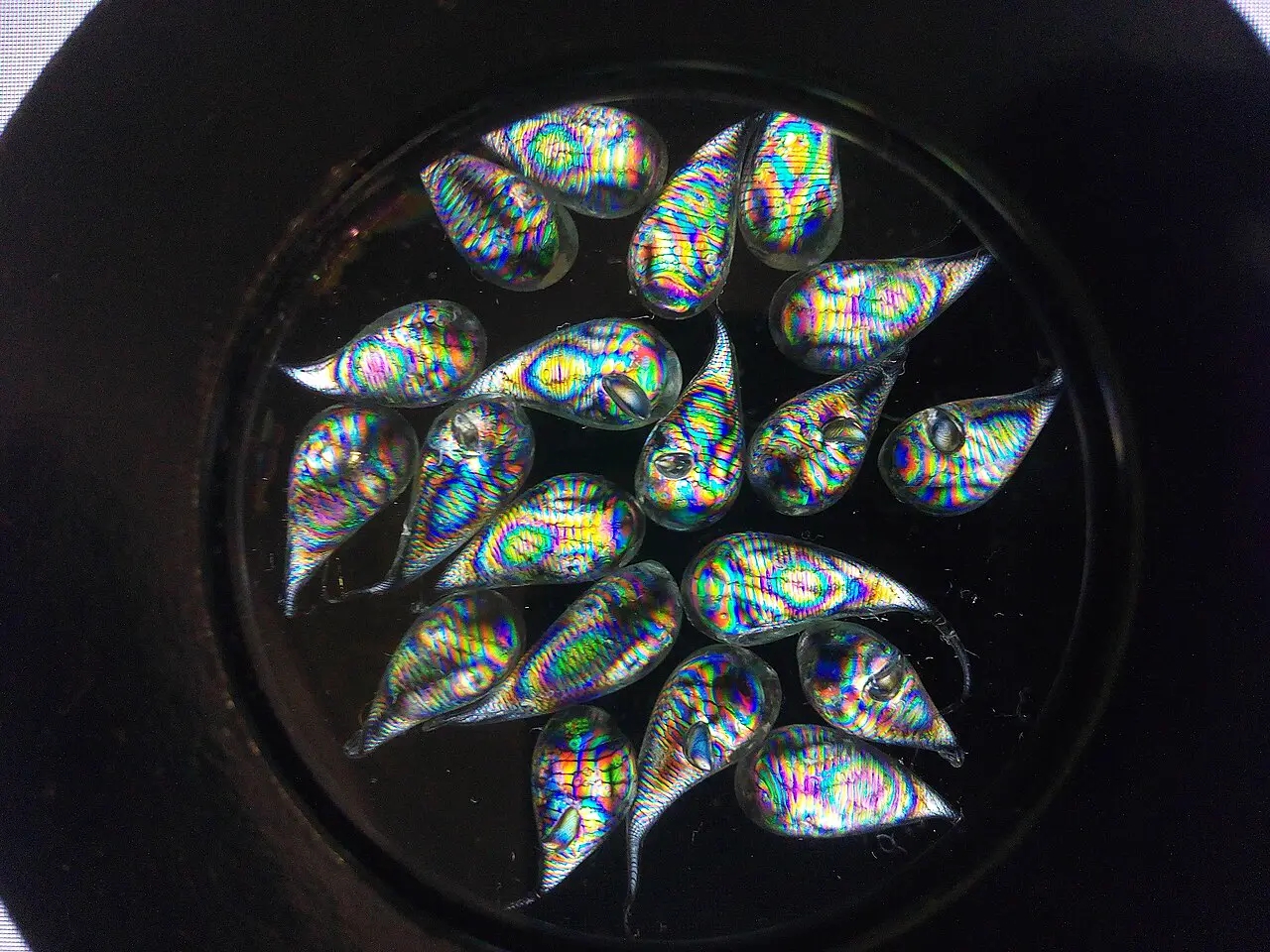
Image credit: ОльгаСебик, via Wikimedia Commons. Licensed under CC BY-SA 4.0. Resized and converted to WebP for this article.

A Prince Rupert's drop is usually made from ordinary soda-lime glass. Its strange behaviour comes from the order in which it cools. The water freezes the outer surface first while the inside remains hot and soft. When the centre later contracts, it pulls against a shell that has already become rigid. The finished drop looks calm and transparent, but it contains a permanent argument between a compressed exterior and a stretched interior.
That argument can sit there for years. A hammer blow to the head may fail to start a crack. Damage the wrong part of the tail, however, and a fracture races through the glass at roughly 1.5 to 1.9 kilometres per second. One laboratory drop was later reconstructed from at least 21,847 fragments.[4][5][6]
The more I read, the less the drop resembled a party trick. It connects a seventeenth-century royal court, Robert Hooke's microscope, the mechanics of broken phone screens, high-speed cameras and current research into volcanic explosions. It is also a very good lesson in why calling a material "strong" tells us less than we think.
What exactly is a Prince Rupert's drop?
The object begins as a small mass of molten glass. When it falls into water, surface tension pulls the leading part into a rounded bulb while the last thread of glass stretches into a narrow tail. Surviving drops often have heads between about 5 and 15 millimetres across. The tail may narrow from a few millimetres to something close to a hair at its end.[4]
Not every molten blob survives. Some crack during the quench, some break after several seconds, and others never form a proper drop at all. Soda-lime glass works particularly well because it has a relatively high coefficient of thermal expansion. It changes size enough during cooling to generate a large internal stress field. Borosilicate glass, designed to tolerate thermal shock by expanding less, is much less cooperative.[7]
The drops have collected several names: Dutch tears, Batavian tears, Prussian tears and glass tears. "Prince Rupert's drop" won in English, even though Prince Rupert neither invented the object nor gave a convincing explanation for it.
The shape matters, but not for the reason people often assume. The bulb is where the compressive shell becomes thick and protective. The narrowing tail eventually gives a crack an easier route into the stretched core. It is less a magical weak point attached to an indestructible bead than an exposed entrance into a loaded structure.
The prince who did not invent them
Prince Rupert of the Rhine was a soldier, naval commander, amateur scientist and cousin of King Charles II. He brought examples of the glass drops to the restored English court in 1660. They were already known on the European continent. Records point to Mecklenburg before 1625, and by the 1650s people referred to them as Dutch or Batavian tears.[1][2]
There are suggestions that glassworkers had encountered the effect much earlier. That would not be surprising. Molten glass, water and accidents have shared workshops for a very long time. A claim that Roman glassmakers definitely understood the drops is harder to support, so I would leave it as a possibility rather than turn it into a neat origin story.
Rupert's contribution was publicity. He showed the drops to Charles II, who sent five "little glass bubbles" to the group of experimenters that became the Royal Society. The record from March 1661 describes two containing liquid and three solid examples. Members visited a glasshouse in Woolwich, ordered more specimens and began testing them. Sir Robert Moray presented a report that August.[1][2]
The Royal Society was barely a year old. Its members were trying to build knowledge by making things, breaking them and recording what happened. A glass bead that ignored a hammer and exploded when its tail was touched was almost designed for them.
The drops escaped the meeting room too. Samuel Pepys encountered them as an after-dinner entertainment in January 1662. Samuel Butler used them in Hudibras. In 1671 the Italian mathematician Geminiano Montanari compared a drop to a kingdom that remains whole until its top is broken and it falls apart into people.[1][2]
This was seventeenth-century viral science. The clip travelled as an object, a demonstration and a metaphor instead of an MP4.
Robert Hooke got remarkably close
Robert Hooke devoted Observation VII of Micrographia to glass drops in 1665. He snapped tails with his fingers and crushed them with pliers. The fragments flew hard enough that, in his words, "some of them pierced my skin."[3]
His engraved plate shows the thin glass pipes used to make the specimens and the finished tadpole-shaped drops. The Royal Society still keeps the 1665 image in its collection.[14]
Health and safety had not yet become a strong part of the experimental method.
Hooke examined intact and broken drops under a microscope. He heated them, cooled them in different ways and compared them with other quenched materials. He understood that the decisive event happened during rapid cooling. The outside hardened before the interior, and the later contraction of the centre left the parts of the glass unable to settle into an unstressed state.
His mechanical picture was not fully correct. Hooke thought of the structure as something like an arch or vault in which every part held the others in position. Remove the wrong piece and the arch collapsed. Modern measurements show that he assigned the stress directions incorrectly, as several later writers also did. The surface is compressed, not stretched.[3][4]
Still, the arch was a useful seventeenth-century model. Hooke had no strain gauges, no high-speed camera and no way to reconstruct a three-dimensional stress field. He correctly tied the behaviour to uneven cooling, stored strain and a disturbance that releases the whole structure. That is an impressive amount to extract from glass fragments and a microscope.
The part he could not see was the actual route taken by the crack. The event was simply too fast.
Glass is strong until a crack finds tension
People describe glass as both strong and fragile because they are usually talking about different tests.
The atomic bonds in glass are strong. A pristine glass fibre can resist tensile stresses measured in gigapascals. Everyday glass performs far worse because its surface is not pristine. Scratches, chips and microscopic flaws concentrate stress at their tips. Pull on the material and a tiny surface flaw can open. Once it starts to grow, brittle glass has little ability to blunt the crack through plastic deformation.
Compression changes the situation. Push the faces of a crack together and it cannot open easily. This is why arches, stone and concrete can carry enormous compressive loads while behaving badly in tension. Glass has the same basic preference.
A Prince Rupert's drop exploits it aggressively. Its surface already sits in compression before anyone touches it. An external blow must first overcome that built-in compression before the surface enters enough tension for a crack to open and travel inward.
This distinction also explains why hardness is not the same as toughness, and why neither word alone describes the drop. Hardness concerns resistance to local indentation or scratching. Toughness concerns resistance to crack growth and fracture. The quenching process does not turn soda-lime glass into a new super-hard substance. A 2016 study notes that thermal tempering does not change its indentation hardness. It changes the stress through which a crack must travel.[4]
The crack-tip version of the explanation
There is a more precise way to describe what the compressed surface does.
Fracture mechanics treats a small flaw as a stress amplifier. For a simple crack under tension, the stress intensity near its tip is often written as:
K_I = Y sigma sqrt(pi a)
Here a is the crack size, sigma is the tensile stress trying to open it, and Y accounts for the geometry. The crack becomes unstable when KI reaches the material's fracture toughness, written as KIC.
The equation explains why an apparently harmless scratch matters. Double the crack length and the stress intensity does not double, but it does rise. Increase the tensile load and it rises directly. Once the threshold is crossed, brittle glass offers very little resistance to further growth.
At the surface of a Prince Rupert's drop, the residual stress has the opposite sign. It is compressive. An applied load must first cancel part of that compression before the effective opening stress at a flaw becomes positive. A shallow scratch can therefore sit in a region where its faces are still being pushed together.
This protection has a hard boundary. Make the flaw deep enough to pass through the compressed layer, or apply enough force to overcome it, and the crack reaches a core already under hundreds of megapascals of tension. The sign of the residual stress flips from helpful to destructive. The same stored stress field that lowered the crack-driving force at the surface now raises it inside.[4]
That is the real source of the drop's apparent contradiction. It does not possess one universal strength. Its resistance depends on where a crack begins, how deep it goes and which part of the stress field it encounters.
How cooling loads the drop
Imagine the process in slow motion.
The molten glass enters the water. The outside loses heat quickly and becomes rigid. At that moment the interior is still hot, expanded and able to flow. The shell forms around a centre that occupies more volume than it will need when cold.
The interior then cools and contracts. It wants to shrink away from the shell, but both regions are parts of one continuous object. The contracting centre pulls the surface inward. The surface ends up squeezed into compression, while the interior is held in tension.
No external force remains attached to the drop. The opposing stresses balance each other inside it. Engineers call them residual stresses because they remain after the process that created them has ended.
This point is easy to miss. The drop is not strong because its atoms were packed into a universally stronger arrangement. It is strong at the surface because the cooling process has already spent part of the material's capacity on compression. Before an outside load can pull the surface apart, it has to cancel that compression.
The price is stored elastic energy. The centre is waiting under tension. If a crack reaches it, the drop can pay for its own destruction.
The invisible stress was finally measured
For centuries the stress pattern was inferred from behaviour and from simpler tempered glass. In 2016 Hillar Aben, Johan Anton, M. Õis, Koushik Viswanathan, Srinivasan Chandrasekar and Munawar Chaudhri mapped it in complete drops using integrated photoelasticity.[4]
Stress changes how transparent glass interacts with polarized light. A stressed region can split light into components that travel at different speeds, a phenomenon called stress-induced birefringence. Put the object between polarizers and the invisible mechanical field appears as bands and colours.
The round, three-dimensional geometry makes quantitative measurement harder than looking at a flat plastic ruler between two filters. The researchers immersed each drop in a liquid with a matching refractive index, sent polarized red light through it, measured optical retardation with a computer-controlled polariscope and used an Abel inversion to reconstruct the radial stress distribution. Their reported spatial resolution was 12 micrometres and the uncertainty was below 5 percent.[4]
The numbers were larger than earlier indentation measurements had suggested.
At the heads of four soda-lime drops, surface compression ranged from about 400 to 700 megapascals. Tensile stress near the centre ranged from roughly 225 to 400 megapascals. The compressed surface layer was only about 0.50 to 0.85 millimetres thick, around 8 to 13 percent of the head diameter in the measured specimens.[4]
For scale, ordinary atmospheric pressure is about 0.1 megapascals. Comparing a directional stress in solid glass with air pressure is not mechanically exact, but it makes the size of the number less abstract. The drop's surface is locked into stresses thousands of times larger while the object sits quietly on a desk.
The measurements also found stress around internal voids. Small bubbles are common in handmade drops, but the stress did not vanish at their boundaries, and earlier high-speed work found that a crack front could cross a void without a noticeable change in speed.[4]
Why the head survives a hammer
A hammer does not merely "push" on the head. Contact between curved glass and a hard surface produces a complicated field. Near the edge of the contact area, radial tensile stresses can form the familiar ring crack that grows into a cone beneath the surface. This is one common way brittle glass fails under a hard point or sphere.
The drop begins with several hundred megapascals of surface compression opposing that tensile field. Small cracks are pressed shut or steered along the compressed outer layer instead of being allowed to dive into the tensile core. A dramatic hammer strike can therefore leave the bulb intact.[4]
In compression tests between tungsten carbide platens, similar drops carried loads around 15,000 newtons. Individual specimens behaved differently. One failed at 11,000 N, another reached 10,000 N without breaking, and drops failed around 18,000 to 19,000 N in other tests. One even broke during unloading rather than at maximum load.[4]
Fifteen kilonewtons corresponds to the weight force of roughly 1.5 tonnes under Earth's gravity. That comparison is useful only as scale. It does not mean a tiny drop can safely support a car. The result came from a particular geometry, carefully aligned hard platens and a small contact area. Side loading, a damaged surface or a different drop may produce another outcome.
The variation matters. Internet demonstrations encourage the idea that every head is indestructible. Laboratory results say something more interesting: the head has an unusually effective barrier against crack initiation, but it is still glass. With enough load, bad contact, an existing defect or a crack that penetrates the compressed layer, it fails.
The tail is a route, not a detonator
The common summary says that touching the tail makes the drop explode. It is memorable and slightly wrong.
The very finest end of a long tail may contain little residual stress. Researchers producing drops for the 2021 fragmentation study found that many survived trimming at the far end. Catastrophic failure occurred when a cut was made closer to the body, where the tail still contained a tensile core beneath its compressed surface.[6]
When a break penetrates that region, the crack no longer has to fight surface compression. It enters glass that is already being pulled apart. Stored elastic energy drives the fracture forward without any further work from the pliers.
This is why the tail looks like a fuse in videos. It gives the experimenter a narrow, accessible place where a small break can reach the core. The reaction is mechanical, not chemical. Nothing burns down the tail and there is no explosive compound in the head.
Could the head be triggered directly? Yes. Any sufficiently severe damage that drives a crack through the compressed shell and into the tensile interior can release the drop. The tail is simply the easiest and most repeatable route.
Could we remove the tail and keep an indestructible bead? Removing it mechanically is exactly what starts the fracture if the cut reaches the stressed region. Heating and annealing can let the frozen stress relax, but then the object loses the stress pattern that gave it unusual strength. Modern glassmakers solve the broader problem in other ways: they temper useful shapes and control their edges instead of trying to turn a laboratory tear into a product.
What happens in the first few microseconds
The eye sees a small snap followed by a cloud. High-speed photography shows a fracture front travelling from the damaged tail toward the head.
In 1994 Chandrasekar and Chaudhri recorded drops at rates up to 500,000 frames per second. They measured crack-front velocities around 1,450 to 1,900 metres per second. Later work with soda-lime glass reported about 1,700 metres per second, while lead oxide glass fractured more slowly, around 1,300 metres per second.[5][7]
At 1,700 metres per second, a crack crosses 5 centimetres in roughly 29 microseconds. Sound in air would travel about one centimetre in the same time. By the time a person hears the crack, the drop is already gone.
The front does not remain one clean crack. It branches into finger-like cracks, then branches again. The process repeats as the stored energy is released. In the central tensile zone, cracks accelerate and multiply. As they approach the compressed surface, they slow and leave different fragment shapes.[5][7]
The 1994 experiments found no strong stress wave that could explain the breakup as a conventional internal blast. Repeated crack bifurcation was enough. The drop disintegrates because the fracture keeps finding loaded glass and creating more fracture surface until the energy has been spent.[5]
The recording below slows one of these events to 456,522 frames per second.[12]
At least 21,847 pieces from one small drop
"Turns to dust" is visually accurate but scientifically vague. In 2021 researchers used micro-computed tomography to count and measure the pieces.[6]
They broke a millimetre-scale drop inside a latex glove so fragments could not escape or undergo many secondary collisions. Another drop was fractured inside a transparent yield-stress gel, which held pieces close to their original positions. The micro-CT resolved fragments down to about 50 micrometres.
One reconstructed drop contained at least 21,847 measurable fragments. The true number was higher because anything below the scanner's resolution disappeared into the category that looks like dust.[6]
The fragment sizes were not distributed like those from unstressed glass smashed by an outside impact. The Prince Rupert's drop showed two exponential size regimes, with characteristic dimensions around 0.31 millimetres and 0.064 millimetres in the measured specimen. That suggests a random branching process with length scales set by the internal stress, not a scale-free cascade caused by continuing external loading.[6]
That is a useful distinction. The pliers contribute almost none of the energy needed to make twenty thousand pieces. They open the door. The stored stress field does the rest.
Does the drop really explode?
In ordinary language, yes. It breaks suddenly, makes a sharp report and throws fragments. "Explosive disintegration" is also the phrase used in the scientific literature.[5]
It is not an explosion in the chemical sense. There is no combustion and no rapidly expanding reaction product. Nor is trapped steam required. Some historical investigators suspected liquid or volatile material inside the head, which was reasonable before the stress field could be measured. Solid drops behave the same way.
The energy comes from elastic strain frozen into the glass. Breaking the tail converts that stored mechanical energy into new fracture surfaces, moving fragments, vibration, sound and heat. The release is self-sustaining once the crack reaches the tensile core.
Calling it an implosion is not better. The crack front moves through the object and fragments are ejected outward. The cleanest description is catastrophic fragmentation driven by residual stress. "Explosion" is fine as long as we remember what supplies the energy.
The bullet videos need context
Some of the most popular clips show a bullet striking the bulb. Depending on the projectile, velocity, angle, support and quality of the drop, the head may deflect or fragment the bullet, chip locally, or fail completely.
The wrong conclusion is that Prince Rupert's drops are bulletproof glass in miniature.
A bullet impact is not equivalent to a slow compression test. It creates intense local stresses, shock, bending and contact damage over a very short time. The tail can also be disturbed by the impact or by the way the specimen is held. A result from one calibre and one handmade drop does not define a material property.
The useful observation is narrower: surface compression can make glass unexpectedly resistant to certain impacts. That principle is real. The viral label "stronger than a bullet" is not a meaningful engineering specification.
What the internet usually gets wrong
Several explanations are repeated so often that they have become part of the object.
"The outside is in tension"
This reverses the measured stress field. The surface is compressed. The core is in tension. Hooke's thermal intuition was good, but his direction of stress was not.[3][4]
"Only the tail can break it"
The tail provides the easiest path into the tensile region. A deep enough crack elsewhere can also start catastrophic failure. High compressive loads eventually destroy the head, and specimen quality changes the threshold.[4]
"The head is unbreakable"
No. It resists specific crack-forming loads exceptionally well. Tests in the same research programme include failures at different loads, sometimes during unloading.[4]
"There is liquid or gas inside that causes the explosion"
Some drops contain bubbles or cavities. They are not the engine. Residual stress exists throughout solid glass, and crack fronts can cross a void without being stopped or triggered by it.[4]
"The water makes a special new kind of glass"
The composition remains glass. Rapid cooling changes its stress state. The same soda-lime material cooled slowly behaves like ordinary annealed glass.[2][4]
"It stores pressure like a sealed bottle"
There is no central pressure vessel pushing uniformly outward. Stress is distributed through the solid. Compression near the surface balances tension inside.
"Every part of the tail is equally sensitive"
The thinnest far end may be almost unstressed and can sometimes be trimmed. The dangerous point is where damage reaches a tensile core.[6]
Tempered glass is the useful relative
Prince Rupert's drops are often described as the first lesson in tempered glass. The relationship is real, though a modern car window is not manufactured by dropping molten windows into water.
In thermal tempering, a finished sheet is heated and then cooled rapidly at its surfaces, usually with controlled air jets. The outside solidifies and contracts before the centre completes its cooling. The result is the familiar pattern: surface compression balanced by interior tension.
The compressed surface makes the sheet stronger against bending and impact. If a crack penetrates into the tensile zone, the stored energy helps divide the sheet into many relatively small pieces instead of a few long blades. That is why thermally tempered glass is used in side windows, shower doors and other places where both strength and fracture behaviour matter.
The process became industrial rather than curious during the nineteenth century. François Barthélemy Alfred Royer de la Bastie patented a method in 1874 that quenched heated glass in oil or grease. Later processes improved control and made flat tempered glass practical.[10]
There is an important design difference. Engineers do not chase the maximum possible residual stress. A useful pane must survive manufacturing defects, edge damage, mounting and temperature changes. It must fail in a predictable enough way to satisfy standards. The Rupert drop is a spectacular extreme, not a sensible window specification.
Your phone screen uses a related idea
Chemically strengthened cover glass reaches surface compression without the same thermal quench.
The glass is placed in a molten salt bath. Larger potassium ions replace smaller sodium ions near the surface. The larger ions crowd the glass network and create a compressive layer. A surface scratch then has to overcome that compression before it can open into a growing crack.[8]
The method, used in products such as Gorilla Glass, can create a deep and controlled compressive layer in thin glass that would be difficult to temper evenly with heat. The chemistry, geometry and stress profile differ from a Prince Rupert's drop, but the fracture lesson is the same: protect the surface by putting it in compression.
This also explains the depressing moment when a phone survives several falls and then breaks from what looks like a gentle one. Earlier impacts may create or deepen flaws. The final event does not have to supply all the damage. It only has to put the right flaw under enough tension to cross the protective layer.
Why we do not build armour from glass tadpoles
The head's strength invites obvious ideas. Pack the drops into a panel. Cut off the tails. Use the bulbs as aggregate. Make bearings or armour.
The geometry defeats most of them.
Each drop is a small, irregular object with a vulnerable route to a highly stressed core. Joining drops introduces contacts, bending and surface damage. Grinding them to fit would attack the compressed layer. A structure made from thousands of independent loaded beads would also contain thousands of opportunities for uncontrolled fragmentation.
The useful technology is not the drop itself. It is deliberate residual stress. Engineers apply that idea to panes, fibres, ceramics, pressure vessels and concrete. Pre-stressed concrete follows a related mechanical strategy: introduce compression where later service loads would otherwise produce damaging tension.
The drop remains valuable because it makes the idea visible. It takes an abstract stress profile and gives it a hammer-proof head plus a self-destructing tail.
Why volcanologists still care about it
In 2022 Katharine Cashman, Emma Liu and Alison Rust used Prince Rupert's drops to study a much larger problem: what happens when hot glassy material meets water during volcanic activity.[7]
Water interacting with magma can produce ash-rich explosive eruptions. Several mechanisms may operate at once, including rapid heat transfer, steam generation, granulation and fracture driven by thermal stress. The small laboratory drops let researchers isolate parts of that process.
They compared drops broken in air, water and viscous syrup. They also studied quench granulation, where molten glass fragmented on contact with water instead of surviving as a stressed drop. Adding bubbles to the melt made proper Rupert drops less likely and promoted immediate granulation. Micro-CT showed that fragments from the compressed outer shell tended to be plate-like, while pieces around internal voids had different, blockier forms.[7]
The work does not mean a volcano is a giant Prince Rupert's drop. Magma contains crystals, bubbles and changing compositions, and an eruption is not a laboratory bead. The drop is a controlled analogue for asking how thermal contraction stores energy and how water changes the resulting fragmentation.
Nature makes tear-shaped volcanic glass too. Pele's tears form when airborne droplets of lava cool into small glass beads, often alongside delicate strands called Pele's hair.[11] They resemble Rupert drops in shape and rapid cooling, but visual similarity does not guarantee the same residual stress field or hammer resistance.
The drop is also an experiment in time
The two contradictory properties are created at different moments.
The strong surface forms first, when water arrests the outside. The dangerous core develops later, when the interior cools and pulls against that shell. The final object remembers that sequence. If every part cooled slowly and had time to relax, there would be far less residual stress and no spectacular disintegration.
This is one reason materials processing cannot be separated from material composition. Two pieces of soda-lime glass can contain the same elements and behave very differently because one was annealed and the other was quenched. Manufacturing history remains inside the object as stress, microstructure and flaws.
Metalworkers know a related lesson from quenching steel, although phase transformations make the metallurgy different. Welders deal with residual stress around joints. Injection-moulded plastics can retain orientation and stress from flow and cooling. A finished object is not only what it is made from. It is also what happened to it.
Seeing the stress at home is safer than making the drop
A simple polariscope uses two polarizing filters with their axes crossed. Place a transparent stressed object between them and rotate it. Regions that would otherwise look clear can show coloured fringes because stress changes the optical path of the light.
This works with plastic packaging, rulers, safety glass and many moulded objects. A Prince Rupert's drop produces a dense, curved pattern, although its thickness and round shape make the image harder to interpret quantitatively. University demonstration collections use this method to show the stress field without breaking the specimen.[9][13]
Making the drop is a different category of experiment. It combines molten glass, an open flame, water, thermal shock and a finished object capable of throwing fine fragments. Hooke managed to drive pieces into his own skin. Three and a half centuries of progress should include not repeating that part.[3]
This is not a kitchen experiment. Proper glassworking equipment, face and eye protection, heat-resistant clothing, shielding, ventilation and someone experienced with molten glass are the minimum context. Even a drop that appears to have survived the water can fail during cooling or handling. A demonstration should contain the fragments before the tail is broken.
Watching the high-speed recording loses very little of the educational value and considerably less skin.
A few details I did not expect
The "Prince" in the name was a skilled experimentalist, not just a royal courier. Rupert worked on metallurgy, gunpowder, printmaking and naval technology. Still, the glass tear was already old news elsewhere when he brought it to England.[1]
The Royal Society's first samples were not all the solid tadpoles shown in modern demonstrations. Its record distinguishes liquid-containing glass bubbles from solid drops. Seventeenth-century investigators were comparing related glass objects while the vocabulary was still unsettled.[2]
Hooke noticed that slowly cooled glass did not behave the same way. Moray reported the same basic control experiment: cool the object in air and it becomes ordinary glass. The essential variable was never a secret ingredient. It was the thermal history.[2][3]
The 2016 strength paper effectively corrected the research team's own earlier estimate. An indentation method had suggested surface compression around 90 to 170 megapascals. Integrated photoelasticity produced 400 to 700 megapascals. Better access to a three-dimensional stress field changed the answer by several times.[4][5]
The crack front can cross an internal cavity without noticeably changing speed. The bubble looks dramatic in polarized images, but the surrounding stress field keeps the fracture moving.[4]
And the final dust is not shapeless noise. Its size distribution and fragment geometry preserve information about the stress field and the route taken by the cracks.[6][7]
Four centuries for a complete answer
It is tempting to say that Hooke solved the drop in 1665 or that modern scientists finally solved it in 2016. Neither version is quite right.
Hooke identified rapid cooling and trapped mechanical strain. Nineteenth-century glassmakers turned related principles into tempering processes. The 1994 high-speed study showed how a crack ran and branched through the tensile region. The 2016 photoelastic work measured why the head resisted crack formation so effectively. The 2021 and 2022 studies counted the fragments and used their distribution to ask new questions about stressed materials and magma-water interaction.[3][4][5][6][7]
The explanation improved because each generation could see a different part of the event. A microscope revealed the fragments. A camera slowed microseconds into visible frames. Polarized light mapped stress in transparent glass. X-ray tomography rebuilt an object after it had ceased to exist.
I like the drop more after removing the magic from it. A magic object is strong at one end and cursed at the other. The real object is better. Every part follows ordinary mechanics, but the stresses were arranged during cooling so that an everyday material behaves in a way our intuition does not expect.
The head and tail are not opposites. They are consequences of the same process. The compression that protects the surface exists because the interior was left stretched. Its strength and its instability were manufactured together.
That is the part the hammer videos usually miss.
Sources and further reading
- The Royal Society Picture Library: Prince Rupert's drop. Archival description of the drops' arrival at the English court, the 1661 Royal Society investigation and Montanari's later work.
- Folger Shakespeare Library: "Whose least part crackt, the whole does fly". A documented account of early experiments, Margaret Cavendish, Moray's report, Pepys and the 1662 English publication.
- Robert Hooke, Micrographia, Observation VII. The full 1665 text of Hooke's experiments and proposed explanation.
- H. Aben et al., "On the extraordinary strength of Prince Rupert's drops". Applied Physics Letters 109, 231903 (2016). Quantitative three-dimensional photoelastic stress measurements and compression tests.
- S. Chandrasekar and M. M. Chaudhri, "The explosive disintegration of Prince Rupert's drops". Philosophical Magazine B 70 (1994), 1195 to 1218. High-speed photography, crack velocity and the repeated bifurcation model.
- S. Kooij et al., "Explosive fragmentation of Prince Rupert's drops leads to well-defined fragment sizes". Nature Communications 12, 2521 (2021). Micro-CT reconstruction and fragment-size analysis.
- K. V. Cashman, E. J. Liu and A. C. Rust, "Prince Rupert's Drops: An analysis of fragmentation by thermal stresses and quench granulation of glass and bubbly glass". Proceedings of the National Academy of Sciences 119 (2022). Fracture media, bubbles, fragment geometry and relevance to hydrovolcanism.
- Corning: How strengthening glass works. An explanation of surface flaws, compressive stress and ion-exchange strengthening.
- APS Physics: Controlling persistent stress in glass. Background on residual stress and photoelastic observation in glass.
- F. B. A. Royer de la Bastie, US Patent 157,717. The 1874 patent for tempering heated glass in a liquid bath.
- USGS: Pele's hair and Pele's tears. Formation and hazards of naturally occurring volcanic glass tears and fibres.
- Smarter Every Day: Prince Rupert's drop at 456,522 frames per second. High-speed footage used as the embedded visual demonstration in this article.
- University of Iowa Physics: Prince Rupert's drops demonstration. Demonstration notes and protective equipment used in a university setting.
- The Royal Society Picture Library: Hooke's 1665 plate. Robert Hooke's microscopic study and illustration from Micrographia.